Silver Lake Monitoring and Treatment Info
2026
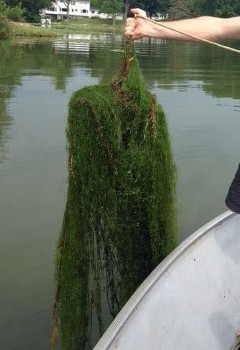
In the most recent June 2026 survey, 10 locations had a rating of 1 with hybrid milfoil found in Silver Lake. Areas are mainly by the boat launch, fishing pier, cove near the beach, and highway (mainly shallow areas).
Lake Survey Map
2024
Fluridone concentration was measured on April 2nd, 2024, and based on the water temperature and weather conditions, and residual concentration post-winter, a second bump treatment was carried out on April 6th, 2024.
After the second bump treatment and fluridone concentration measurement in late April, it was decided a quick survey of plant growth would be useful for determining if another bump treatment would be necessary to support the treatment's effectiveness. On Friday May 3rd, Paul Kaari (Lake Improvement Consulting), Keegan Lund (SePRO), Amber White (SLIA), and April Londo (MNDNR) conducted a short plant survey to look at growth of Eurasian/Hybrid watermilfoil and Curly-Leaf Pondweed. During this survey trip, they saw enough surviving plant material and some new growth of Eurasian/hybrid watermilfoil to warrant a third bump treatment, which was conducted on May 8th, 2024.
2023
Individual Shoreline Treatment Application Form (Deadline: Monday, April 17 at noon)
Fluridone Treatment:
The initial treatment took place on October 2nd, 2023, and was applied directly to the waterbody using underwater application. Following initial Fluridone application, water samples were collected to monitor Fluridone concentration to ensure a sufficient concentration for treatment to be successful. Water samples were collected at two different locations in the waterbody: near the public beach and near the boat launch. Water samples taken approximately 5 days after application showed a successful treatment that dosed the lake within the targeted 2-4 part per billion (ppb) range, with an average lake wide concentration of 2.85 ppb.
Water samples were collected at 14 days and 28 days post-initial fluridone application, and determined an additional, smaller application of fluridone was needed to maintain lake-wide concentrations. This “bump” treatment occurred on November 3rd, 2023, which included another water sample and concentration measurement on November 10th to ensure sufficient concentration for winter.
2021
Individual Shoreline Treatment Application Form (Deadline: Monday, March 22 at noon)
2019
Lakeshore Treatment Options
2018
Monitoring for Aquatic Invasive Species this year turned up low counts of Curly Leaf Pond Weed and Eurasian Water Milfoil so it was determined that no treatments were needed in 2018. Additional Native plants were found indicating improvement to the health of Silver Lake.
2017
Lake Treatment took place May 15th in the southwest bay of Silver Lake. The treatment will help control Curly-leaf Pondweed, an invasive aquatic plant. A concentration of the invasive plant was found in the southwest bay of the lake. An area of 3.2 acres in the bay was treated.
2016
On May 6th, 2016 two small portions of the lake were treated for control of Curly-leaf Pondweed, which is an invasive aquatic plant. The two areas are the small bay at the boat launch and the bay in the northwest corner of the lake. Both had significant infestations of Curly-leaf Pondweed. The treatment covered a total of 2.6 acres.
2015
DNR August Point Intercept Study Results
In May we treated the major bay areas of the lake for the invasive Eurasian watermilfoil. Lake Improvement Consulting is our service contractor that did the treatments.
How will I know when the lake is treated?
We will place bright orange posting notification signs on the shoreline, and then will place buoys in the areas being treated. It will be the responsibility of the homeowners/association to remove the signs by the take-down date specified on the orange posting.
How long should people and pets stay out of the water in the treated areas?
According to the label specifications, there are no swimming restrictions, however, the DNR prefers (and it is best practice) to put a one-day restriction on swimming and fishing activities. The primary restriction is for using the water for drinking purposes. The orange signs will list the exact product label restrictions for the treated areas.
How long should people and pets stay out of the water in other areas?
There are no restrictions for untreated areas.
Is it OK to swim at the beach or should it be closed?
The restrictions are only for the designated treated areas. The beach is not included in the treatment area, however we will be treating very close to the beach.
2014
We have been successful in receiving a grant for $1065 from the DNR to help offset the cost of treating to control the spread of invasive species in Silver Lake. The week of July 21st we will be treating the areas shown on the treatment map. The treatment areas proposed by SLIA were modified and reduced by the DNR after their inspection of the lake, due to the presence of native water lilies in the bays that would be adversely affected by the treatment. Lake Improvement Consulting is our service contractor that will be doing the treatments. Our grant will help defray the $3080 treatment cost. Below are some questions and answers about the treatment.
How will I know when the lake is treated?
We will place bright orange posting notification signs on the shoreline, and then will place buoys in the offshore area in the northern bay by the public landing area. It will be the responsibility of the homeowners/association to remove the signs by the take-down date specified on the orange posting.
How long should people and pets stay out of the water in the treated areas?
According to the label specifications, there are no swimming restrictions, however, the DNR prefers (and it is best practice) to put a one-day restriction on swimming and fishing activities. The primary restriction is for using the water for drinking purposes. The orange signs will list the exact product label restrictions for the treated areas.
How long should people and pets stay out of the water in other areas?
There are no restrictions for untreated areas.
Is it OK to swim at the beach or should it be closed?
The restrictions are only for the designated treated areas. The beach is not included in the treatment area.
2013
In May the Silver Lake Improvement Association conducted a center lake treatment targeting the aquatic invasive species of Eurasian watermilfoil and curly-leaf pondweed. The chemicals DMA4 and Aquathol K were used to treat those invasive species.
Land owners wanting to pursue individual shoreline were allowed to do so themselves using DNR's permit application form. SLIA did not coordinate a group shoreline treatment in 2013.
2012
- Summary of 2012 Treatments
- Silver Lake Plant Frequencies 2010-2012
- April Curlyleaf Pondweed Assessment
- Draft July Point Intercept Report
Treatment Consultant: Lake Improvement Consulting LLC